
Every so often, a question appears that seems straightforward but reveals a deeper misunderstanding:
“If Inference-Based Cognitive Behavioral Therapy (I-CBT) helps people face situations they’ve been avoiding, isn’t that just exposure with a different name?”
The exposure therapy in question is Exposure and Response Prevention (ERP), the long-standing behavioral standard for treating obsessive-compulsive disorder (OCD). The comparison is understandable, but misleading. From a distance, I-CBT may look as if it leads people back into situations they once feared, much like ERP. Yet what happens in I-CBT is not exposure at all — it’s the natural reconnection to reality that follows the correction of a reasoning error.
The confusion often arises from focusing on what a client is doing rather than why they’re doing it. And in OCD, that “why” makes all the difference.
Where ERP works in the realm of behavior and learning, I-CBT operates in the realm of reasoning and inference. ERP teaches you to face fear to learn it’s safe. I-CBT helps you see that the fear was never grounded in reality to begin with.
1. Exposure is behavioral; I-CBT is inferential
ERP is built on behavioral learning. The client approaches a feared situation to gather new information: “I touched the doorknob and nothing bad happened.” The goal is to modify fear expectations and learn that anxiety and uncertainty can be tolerated.
I-CBT starts from a completely different premise. It does not ask the client to test their fear to find out whether it’s real. It begins by showing that the obsessional doubt was never based in reality to begin with. The issue is not that the feared situation might be dangerous. It is that imagination suggested the possibility, and reasoning treated that imagined possibility as relevant to reality, even though it was not grounded in direct sensory evidence.
The engine is not fear; it is a reasoning confusion that elevates an imagined possibility to a relevant consideration, treated as if it deserves investigation. The problem is not belief in danger but granting relevance to a scenario born entirely of imagination.
Reality Sensing, the term sometimes mistaken for “exposure,” is not a test of fear. It is a reconnection to what has been known all along through your senses.
2. The feared situation in I-CBT is imagined, not real
ERP targets real-world stimuli that have become linked to fear: touching, checking, driving, thinking, remembering. I-CBT steps back and asks a more fundamental question: what made that situation feel threatening in the first place?
The answer lies in inferential confusion, the process of using imagination to reason about what might be happening instead of relying on what’s actually known through the senses. The person does not “believe” the feared story but treats it as if it might matter, as if the imagined line of reasoning could be true.
So when someone feels “contaminated,” it’s not because they truly observed contamination. It’s because their imagination created the possibility of it, and that imagined possibility was treated as relevant , as something that required checking or neutralizing, even though no sensory evidence supported it.
Reality Sensing is letting the testimony of your senses stand: “I heard the click, felt the knob stop, and saw the glow fade,” instead of letting imagination script a parallel world.
In I-CBT, the goal isn’t to face danger but to see that danger was imagined from the start. Reality Sensing is not about disconfirming a fear but about ceasing to reason from imagination altogether.
In ERP, doubt is treated as something to tolerate.
In I-CBT, doubt is recognized as a reasoning error that can be unlearned.
3. Reality Sensing is the result, not the treatment
This distinction is essential.
In ERP, exposure is the treatment. It’s the core process through which new learning takes place.
In I-CBT, what might appear as exposure, the process called Reality Sensing, is the end result of the treatment, not the method itself.
 Reality Sensing only emerges once the faulty reasoning behind obsessional doubt has been dismantled. It isn’t an act of facing fear or testing safety; it’s the moment a person naturally returns to the reality that was always there but had been overshadowed by imagination.
It isn’t fear confrontation or proof-seeking; it’s the quiet return to what’s already known, where the absence of catastrophe is its own testimony.
Reality Sensing represents the restoration of trust in one’s senses and in oneself. It marks the point at which reasoning and perception realign, and the imagined story loses its hold.
4. Different mechanisms of change
ERP produces change through behavioral learning, specifically inhibitory learning. The person learns that the feared event doesn’t happen and that anxiety can be tolerated until it fades.
I-CBT produces change through reasoning correction. The person identifies the inferential chain that led them away from direct reality, the leap from sensory evidence into imagination, and stops engaging in that process.
I-CBT moves upstream, before doubt forms, while ERP works downstream after doubt has taken hold.
When Reality Sensing occurs, it’s not exposure to feared stimuli. It’s a perceptual and inferential realignment. The emphasis isn’t on learning that the world is safe, but realizing that the danger was never substantiated, and therefore never relevant in the first place.
ERP modifies fear-based learning.
I-CBT restores reasoning.
5. Facing fear is incidental, not curative
It’s true that as people progress through I-CBT, they often stop avoiding situations they once feared. But that change is incidental, not curative.
Avoidance dissolves naturally once the imagined threat loses its relevance. When the reasoning that sustained the doubt collapses, the behaviors built on it lose their purpose.
ERP measures progress by how well anxiety is endured; Reality Sensing treats lingering anxiety as a signal that obsessional reasoning has crept back in. Once the reasoning error is corrected, anxiety fades naturally, without needing to be “sat with.”
To say I-CBT “involves exposure” because clients re-engage with life is like saying a recovered agoraphobic “did exposure” simply because they now walk outside again. The behavior may look similar, but the internal process that made it possible is completely different.
6. Similar outcomes don’t mean identical processes
ERP and I-CBT may sometimes produce similar visible results — less ritualizing, more trust in self and world — but that doesn’t make them the same.
ERP’s essence is learning that the feared event is unlikely.
I-CBT’s essence is realizing that the feared event was imagined and treated as relevant.
ERP modifies the sense of likelihood within the story the mind has already created.
I-CBT restores the distinction between imagination and reality itself.
One engages with the story to lessen its impact; the other steps beyond it into daylight and ordinary ease. The goal isn’t to endure the scene; it’s to walk outside.
That’s not a semantic difference; it’s a philosophical one. ERP works in the realm of fear and uncertainty. I-CBT works in the realm of reasoning and doubt.
7. On fear extinction and inferential confusion
Exposure-based learning can sometimes reduce inferential confusion indirectly, because when rituals stop, reasoning quiets naturally. But in I-CBT, inferential confusion is not treated incidentally; it’s the direct target of therapy.
ERP’s focus is on tolerating and re-evaluating uncertainty.
I-CBT’s focus is on understanding how “uncertainty” was constructed in the first place.
Calling Reality Sensing “exposure” is a category error: there’s no meaningful fear to confront when the premise itself is fictive. The obsessional scenario was never relevant; it was only imagined.
ERP teaches that danger is improbable.
I-CBT reveals that danger was imagined and granted relevance where none existed.
Both may bring relief, but the path to that relief couldn’t be more different.
8. Intent — The Bridge Between ERP and Reality Sensing
Intent is the unseen element that defines every therapeutic act. It determines whether a person is reinforcing obsessional doubt or dissolving it altogether. Two people can perform the same action, but for entirely different reasons, and those reasons shape the outcome.
When someone refrains from checking the stove to learn that nothing bad will happen, or to see if they can handle uncertainty and tolerate the anxiety that follows, the act stays within the logic of ERP, and arguably, within the very logic of OCD itself. The person remains engaged with doubt, still granting it relevance, still testing its implications. The goal is to endure the uncertainty long enough for new learning to occur.
But if they refrain because they already know the stove is off — because they saw it, heard it, and felt it click — the act follows the logic of I-CBT. It flows from clarity rather than confrontation. No test, no endurance, no negotiation with possibility; only the simple return to what is already known.
Intent is what separates behavioral resistance from inferential correction. ERP asks you to stay in doubt long enough for new learning to take place. I-CBT invites you to recognize that the doubt itself was never valid, making endurance and testing unnecessary.
The same outward behavior — touching a doorknob, resisting a compulsion, turning away from reassurance — can either keep obsessional reasoning alive (when done to test, learn, or confirm) or dissolve it completely (when done from trust in what is already known). The act itself is not what defines the change. The reasoning behind it does.
When intent is grounded in clarity, actions unfold effortlessly. When intent is grounded in tolerance, testing, or learning from anxiety, doubt remains active. The measure of progress in I-CBT is not how much anxiety one can endure, but how fully reasoning has been restored to reality.
When that shift occurs, OCD’s mechanism collapses. You are no longer “living with uncertainty.” You are living without false relevance, no longer in negotiation with imagination, but grounded once again in what is real.
9. Final reflection
ERP and I-CBT share a compassionate aim: helping people reclaim their lives from OCD. Both require courage and honesty. Both can lead to deep recovery. But they do so through fundamentally different frameworks.
ERP is a theory of fear correction.
I-CBT is a theory of reason correction.
ERP helps clients learn that danger is unlikely.
I-CBT helps them see that danger was never real — never relevant — to begin with.
ERP begins with exposure.
I-CBT ends with Reality Sensing — the quiet return to what has always been trustworthy, real, and one’s own.
One asks, “What if it’s safe after all?”
The other asks, “Was it ever real to begin with?”
Both can lead to freedom, but through entirely different doors of the mind.
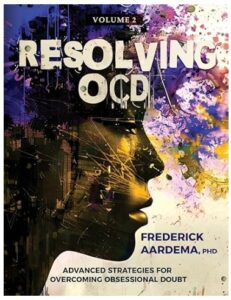
For readers or clinicians who want a complete exploration of these distinctions — how imagination, reasoning, and sensory trust interact to produce and dissolve obsessional doubt — the full theoretical and clinical framework is presented in The Resolving OCD series.
 References
Aardema, F. (2024). Resolving OCD, Volume 1: Understanding Your Obsessional Experience. Mount Royal Publishing.
Aardema, F. (2025). Resolving OCD, Volume 2: Advanced Strategies for Overcoming Obsessional Doubt. Mount Royal Publishing.
Aardema, F. (2025). The Doubt Illusion: A Compact Guide to Overcome OCD with Inference-Based Cognitive Behavioral Therapy. Mount Royal Publishing.
© Frederick Aardema, PhD.— The Doubt Illusion Blog (2025)


Every time I read something you write, I learn something more. This is so clear and understandable.