
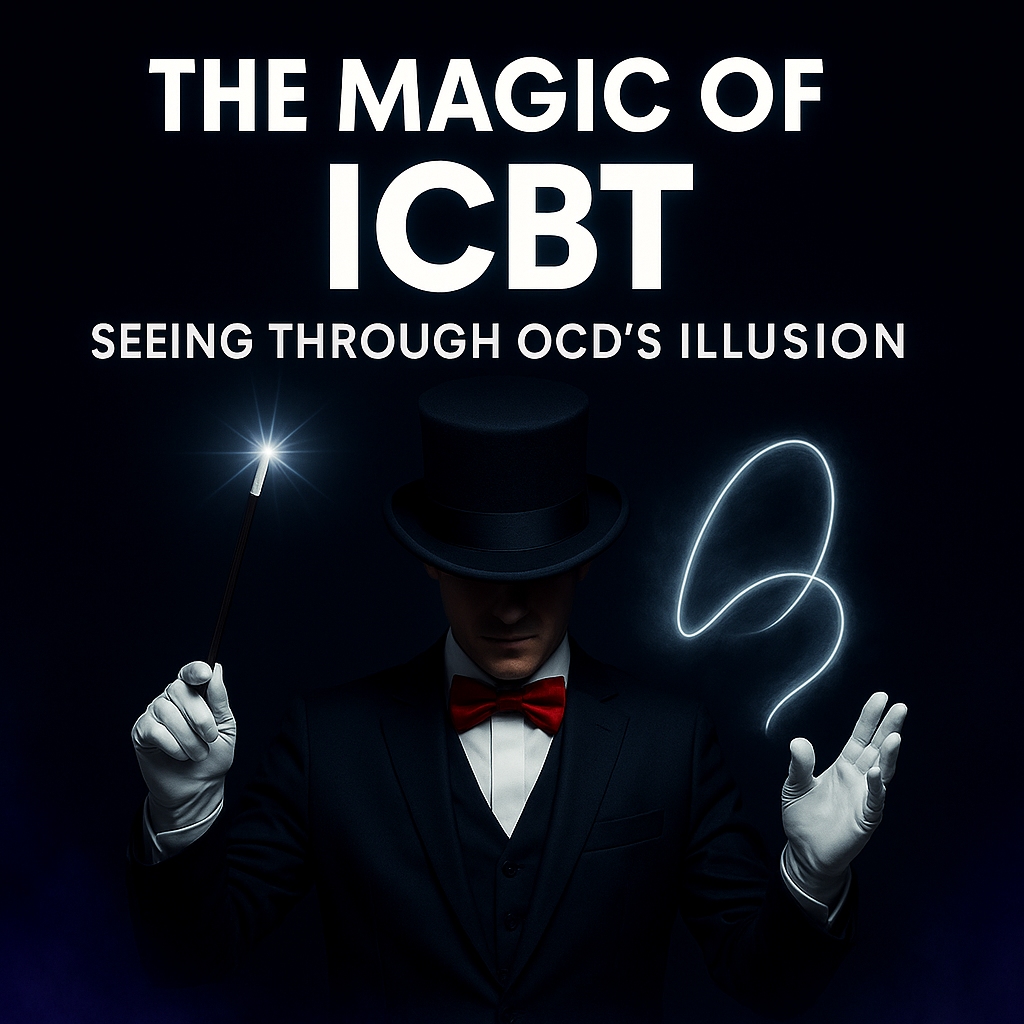
Illusion has always offered one of the clearest metaphors for understanding obsessional doubt.
Not the trivial kind, rabbits in hats or cards up sleeves, but the deeper magic of psychological illusion: the kind that reshapes perception, redirects attention, and persuades an audience to believe in a reality that is not there.
From its earliest ideas, Inference-Based Cognitive Behavioral Therapy (ICBT) drew on this logic of illusion.
Magicians understand how attention can be redirected, how a fictive layer can be projected over reality, and how the mind supplies what is never actually shown. They know that an illusion acquires its force not from deception but from cooperation.
ICBT emerged from this same recognition: OCD behaves not as a detector of danger but as an illusionist — using misdirection, imaginative projection, and emotional vividness to make what is unreal feel immediate and consequential.
The Mental Behind Obsessional Doubt
Every illusion begins with a small betrayal of attention.
A glint of movement.
A pause held just long enough.
A gesture that draws the audience’s eyes away from the mechanism of the trick.
 The illusionist does not need smoke or mirrors.
He needs only the mind’s tendency to follow the most compelling story in the room.
OCD performs its illusions with comparable finesse.
A person sees the stove turned off, the door locked, their memory intact. Reality is unambiguous.
But then comes the shift — a moment of cognitive misdirection. The mind pulls attention inward, away from perception and toward a possibility it has begun to imagine:
What if something slipped past me when I checked the stove, a tiny glow I did not notice?
What if I did not truly see the door latch click into place, maybe it only felt locked?
What if something happened while I was driving, a bump I barely sensed or a pedestrian I somehow failed to notice?
This is the moment the illusion begins.
A second layer is cast over the real one.
The mind leans into the story, following its shadows instead of the world’s light.
This is not uncertainty.
This is illusion — a substitution of one reality for another, executed with the precision of mental sleight of hand.
The Illusionist’s Image, and the Image in the Mind
A skilled illusionist can make an apparition seem to appear out of nothing, a shape or shimmer or suggestion of presence that feels real for a moment, even though nothing is actually there. The power of the illusion lies not in the object but in the audience’s readiness to complete what has only been suggested.
Obsessional doubt works in exactly this way.
The imagined danger has no external substance, no trace, no evidence, no contact with the real world. Yet through emotional intensity and repeated attention, the mind grants the imagined possibility a sense of presence it does not possess.
The person becomes both illusionist and audience, watching an internal performance unfold and reacting as though the apparition were truly before them.
The illusionist does not need a real figure.
The audience supplies the missing form.
Likewise, OCD does not need evidence — the mind supplies the missing threat.
And just as a magician relies on the audience’s momentary absorption in the illusion, OCD relies on the person’s brief shift into the imagined narrative, vivid enough to eclipse the simplicity of what the senses are actually showing.
Where Magic, Narrative, and OCD Meet
Illusion is not only trickery; it is storytelling.
A shift in tone, a change in rhythm, a pause held for a fraction longer than expected: these are the cues that prompt the audience to generate meaning.
OCD uses the same logic of illusion.
A person performs an ordinary action.
Then imagination offers a cue: What if…?
That cue becomes a narrative seed.
From it grows a scene:
Emotional stakes, moral consequence, a cascade of imagined outcomes.
Nothing has changed in the world.
Everything has changed in the person’s internal theatre.
This is magic without a stage, illusion without a performer — the mind becomes playwright, actor, director, and audience all at once.
The Architecture of Cognitive Illusion
Every illusion follows a structure as clean as a blueprint:
- Divert attention from reality.
A gesture here, a shadow there, enough to shift the gaze. - Introduce an imagined alternative.
Not as fact but as something the mind can lean into, elaborate, and animate. - Infuse the imagined with emotional weight.
Emotion gives the illusion its gravity and urgency. - Allow sensation to masquerade as evidence.
A knot in the stomach becomes “proof,” a flash of guilt becomes “signal.”
This is the architecture of obsessional doubt.
It explains why a person can know nothing happened and yet feel drawn toward checking or reviewing.
The internal illusion has succeeded.
Reasoning drifts from evidence toward narrative.
ICBT exposes this architecture.
It illuminates the misdirection.
It reveals how imagination overtook perception.
And once the mechanism is seen clearly, the illusion collapses — not dramatically, but with the quiet inevitability of something that can no longer pretend to be true.
The Return to Direct Reality
 ICBT does not ask anyone to fight thoughts, argue with content, or “tolerate uncertainty.” It invites something simpler and more radical: to notice the moment the mind exits the real world and enters the imagined one.
When attention returns to the senses, to what is present here and now, the illusion dissolves like smoke under bright light. What looked like danger is revealed as a cognitive projection, a magician’s flourish, a phantom crafted by reasoning rather than reality.
Magic, at its purest, relies on a temporary disconnection from direct perception.
Obsessional doubt depends on that same disconnection.
ICBT restores the contact.
This is, at its core, the theme explored throughout The Doubt Illusion: obsessional doubt is not a riddle to solve, nor a danger to guard against, but an illusion of reasoning. And the moment you see how the trick is done, the urgency dissolves — and reality, steady and unembellished, reappears exactly where it always was.
References
Aardema, F. (2025). The Doubt Illusion: A Compact Guide to Overcome OCD with Inference-Based Cognitive Behavioral Therapy. Mount Royal Publishing.
© Frederick Aardema, PhD.— The Doubt Illusion Blog (2025)
