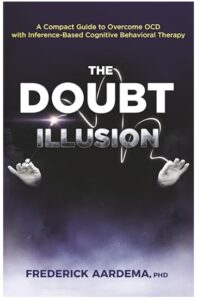
INTRODUCTION TO THE DOUBT ILLUSION
We all know doubt as a quiet companion — the nudge that makes us double-check if the stove is off or rethink a choice before committing. In its ordinary form, doubt keeps us careful, thoughtful, and safe.
But sometimes doubt stops being a companion and becomes a captor. It gets louder, relentless, and consuming. Instead of clarifying, it entangles.
You chase reassurance, but it never sticks. You reason, and the reasoning backfires.
What you’re left with isn’t ordinary doubt anymore. It’s obsessional doubt — an expert illusionist that takes imagination and dresses it up as reality.
What masks as an innocent question — Did I lock the door? Did I say the wrong thing? — is already part of the illusion. The thought doesn’t simply appear and spiral; it enters on cue, after imagination has quietly prepared the stage.
If you’ve ever found yourself replaying conversations, second-guessing your motives, or stuck in the tug-of-war of what ifs that refuse to resolve, this book is for you.
Not because you need a diagnosis, but because doubt has begun to steal your peace, drain your energy, and crowd out the simplicity of living.
Traditional approaches to managing these doubts often advise us to “accept uncertainty” or simply “sit with distressing thoughts.” Yet what if uncertainty itself isn’t the issue? What if your mind is playing a trick on you — using flawed logic and vivid imagination to create doubts out of thin air?
That’s where Inference-Based Cognitive Behavioral Therapy (ICBT) comes in — not as a new coping tool, but as a new lens.
ICBT treats obsessional doubt as a cognitive illusion — much like the act of a mime artist or magician. The performance may be convincing, complete with tension, drama, and perfect timing, but there’s no real threat behind it. The illusion works because attention and imagination have been cleverly misdirected. Once you spot the sleight of mind, the effect dissolves.
ICBT is a scientifically validated, evidence-based treatment developed specifically for obsessive-compulsive doubt. Its effectiveness has been demonstrated in multiple research trials, and its principles are now applied worldwide by mental health professionals. This book distills those proven methods into a clear, conversational guide you can use in daily life.
Unlike traditional CBT models that often emphasize confronting fears or tolerating discomfort, ICBT focuses on how obsessional doubt is constructed — through imagination and reasoning errors that disconnect you from direct reality. Once you see this clearly, the fear begins to lose its hold. You don’t have to white-knuckle your way through. You just have to recognize that the alarm was false all along.
This book is full of metaphors designed to give you the right key to break the illusion. ICBT is not a therapy of sheer effort or endurance — it’s a therapy of realization and insight. Storytelling is part of that, because good metaphors change how you see.
The aim is not to expose you to OCD, as in some behavioral approaches, but to expose OCD itself — to the flame of reality. Not by dismissing imagination, or saying you’re just “making things up,” but by bringing imagination back into alignment with reality. OCD thrives on their misalignment. ICBT brings them back together — and that’s where freedom begins.
This book draws from the same clinical foundation that informed the Resolving OCD series — the official guide and workbook written to give individuals and therapists a full therapeutic roadmap for applying ICBT in depth. Both projects were written in parallel over the past few years, designed to offer two distinct formats for overcoming obsessive-compulsive doubt: one comprehensive and structured, the other concise and conversational.
If Resolving OCD is a full-sized toolbox — heavy-duty, with every possible instrument you might need for a complete overhaul — The Doubt Illusion is the well-crafted pocketknife you carry in your pocket: light, simple, and built for everyday use. Think of it not as a shortcut, but as a different entry point — one that brings clarity through simplicity.
Both tools serve the same goal — to free you from the grasp of obsessive doubt — but they meet you at different points on the journey. You don’t always need the entire toolbox to fix the lock. Sometimes, all it takes is the right key.
This book isn’t only for “milder cases.” If you’re struggling with severe OCD, you may still find relief here — either as a starting point or a companion to more in-depth work. It’s for anyone who’s ever felt stuck in their head — replaying thoughts, second-guessing choices, or overanalyzing moments that never resolve. If your mind often feels busy but never at peace, this book will help you see how obsessional reasoning keeps you trapped — and how to step out of it.
Across seven chapters, we’ll gently unravel how obsessional doubt works — not by fighting every fear, but by exposing the process that made the fear feel real. Through vivid metaphors and real-world examples, you’ll learn to stop wrestling with every what if and start walking right past them.
ICBT teaches a profound insight: your doubts often weren’t grounded in reality to begin with. They were vivid, plausible, and emotionally gripping — but still just stories. And the more you learn to see them that way, the freer you become.
This guide won’t just help you manage your doubts — it aims to free you from their pull completely. As you read on, you’ll come to understand that obsessional doubt never represented a genuine problem to solve. It was, and always has been, just an illusion waiting to be unmasked.